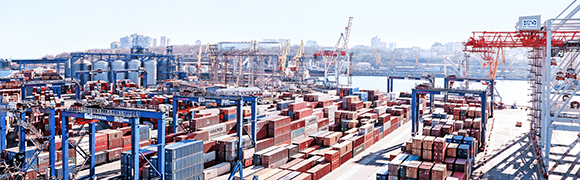
Odessa – The gate to the world
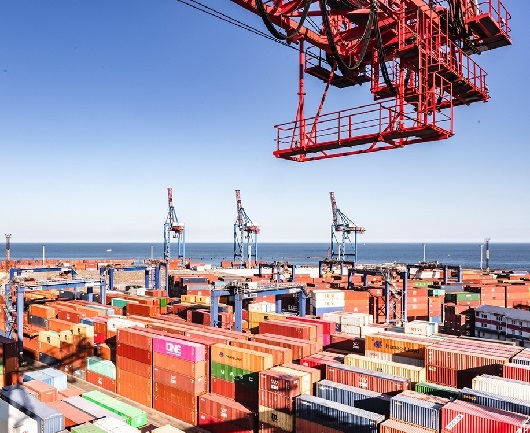
A magnificent stairway provides an unobstructed view of the port, which lies close to the old town and spreads along the seafront with its quayside facilities, cranes, silos and railway tracks. Sergei Eisenstein shot some of the scenes for his world-famous film The Battleship Potemkin here in 1925. The stairway is a symbol of the City of Odessa on the Black Sea.
The port is situated directly in front of this tourist attraction, and all visitors are checked at the entrance without exception. Philip Sweens, the Managing Director of HHLA International, is familiar with this, as he is regularly in Odessa. This is an important part of the Hamburg port company’s international business. HHLA operates the biggest terminal in the Ukrainian city. Sweens shows his port ID to the guard at the gate, and the driver then takes him out to the facilities, past dense construction sites. The city is the port, and the port is the city – just like in Hamburg. “Odessa is Ukraine’s most important port – in general, and in particular for container handling. However, it is completely surrounded by the city,” says Sweens. “We have to work and plan around this restriction.” The most efficient port The city is now home to the country’s most efficient port which isn’t blocked by its larger neighbour Russia. Talking to those in charge at the port, it is clear how important it is economically and strategically – as well as for investors such as HHLA. Odessa is located approximately 300 kilometres northwest of Crimea and has increased significantly in importance for Ukraine since Russia annexed the peninsula in 2014. Although the war in eastern Ukraine is considered to be “on ice”, the fronts between Ukrainian troops and separatists are largely entrenched. However, the situation can quickly escalate again. At the end of November, a Russian marine ship rammed a Ukrainian marine ship in the Kerch Strait between Russia and Crimea. Russian specialist units seized three Ukrainian ships and arrested 24 sailors, who have been held in Russian custody since then. Since occupying Crimea, Russia has controlled the Ports of Sevastopol and Yalta. In addition to that, Russia can prevent access to other Ukrainian ports located behind Crimea in the Sea of Azov, such as the important industrial Port of Mariupol. “The situation in the Sea of Azov isn’t so critical for loading cereals, but it is for other commodities like steel,” says Anastas Kokkin, head of the HHLA terminal, whom Sweens meets at the administration building. Kokkin points to stacks of steel sheeting rolls in an adjacent port facility: “A lot of steel exports which used to be shipped through Mariupol now go through Odessa.”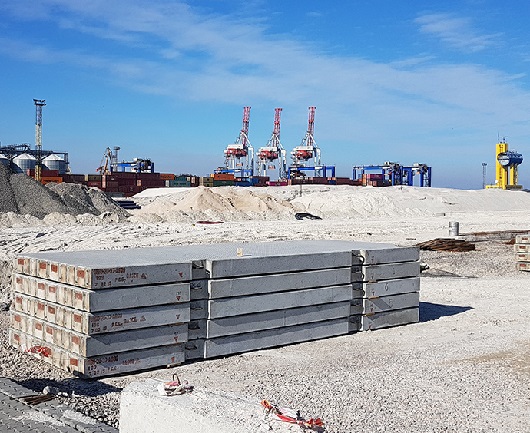
The two countries have age-old links with each other, which prompt violence and tension nowadays. Ukraine itself was once part of Russia. In 1794, the tsarina Catherine the Great established Odessa so that her empire would have better access to the Black Sea and the Mediterranean Sea, for both marine vessels and freight ships. Odessa is just as important for foreign trade today as it was back then – and therefore very attractive to foreign investors.
A subsidiary of HHLA purchased the terminal in Odessa in 2001. Russia and the other former republics of the collapsed Soviet Union were in the process of reorganising themselves as independent countries, including Ukraine. Investors from Western Europe were extremely welcome. At the time, nobody expected that there would be tense confrontations between the European Union and Russia again. However, then Russia occupied Crimea. At the same time, the war in eastern Ukraine escalated, with Moscow supporting the separatists, who are fighting for annexation by Russia.
HHLA has invested $ 150 million
HHLA did not allow itself to be detracted by the upheavals. Since 2005, the company has invested $ 150 million in modernising the terminal and doubling its size. “This is one of the biggest investments by a German company in Ukraine. The terminal has become the most modern in the country as a result,” says Sweens. With a surface area of 35 hectares now, the facility in Odessa is still only around half the size of Tollerort, the smallest HHLA terminal in Hamburg. However, for an emerging market like Ukraine, this makes it a heavyweight. Sweens and Kokkin drive across the premises to view the expansion. Three new container gantry cranes are already on the quayside, while workers are preparing for the construction of container stores. In addition to steel containers, an increase in the transportation of other goods is expected. The facility is being further developed into a multi-purpose terminal,” says Sweens. “We also handle heavy project cargo here, such as equipment for the oil industry. The handling of wheat could also be an important growth factor.” The HHLA container terminal in Odessa is now the third-largest on the Black Sea. The facility accounts for approximately 40 percent of Ukraine’s container throughput, handling 338,000 container units (TEU) last year. The focus is on the future here. “Ukraine wants to further increase its foreign trade despite the political problems,” says Vassiliy Vesselovski, head of the Ukrainian consultancy firm Informall B. G. “The HHLA terminal is likely to increase its volumes further as a result, as well as its market shares.” The terminal can already handle up to 850,000 TEU annually, and even more capacity is planned. The HHLA facility is growing, despite all the economic and political problems. However, the tensions between Russia and Ukraine are not expected to ease. At the end of March, the Ukrainians will elect a new president. In addition to the incumbent, Petro Poroshenko, the opposition politician Yulia Tymoshenko is running for office again. “Russia has fundamentally no interest in ending the conflict in eastern Ukraine,” says an experienced political observer in Odessa, who doesn’t wish to be named. “As long as Ukraine is in a territorial conflict with a neighbouring country, NATO’s statutes prevent it from becoming a member.”